
Quick answer: Every open enquiry needs a named owner, a specific next action and a due time. Move its stage only when something observable happens, and stop reminders when the customer replies, declines or asks you to stop. Review unassigned and overdue work before counting conversion.
- Free lead follow-up worksheet
- Start with five fields the team will actually maintain
- Define stages by evidence, not optimism
- Set a response rhythm your team can keep
- Three messages that have a job
- Test the awkward cases before automating
- Review the queue without flattering the numbers
- A one-page operating card
- Useful detail: Keep a private reminder separate from a shared commitment
Free lead follow-up worksheet
Copy a blank record and compare it with the clearly fictional example.
Download the free CRM worksheet pack (ZIP)
No signup. Three editable plain-text worksheets; open 01-lead-follow-up-worksheet.txt after unzipping. Version 1.0 · September 30, 2026.
Jump to: Practical table · Checklist / record
For: small teams responding to people who have asked about their services. This is an original workflow proposal, not a cold-outreach campaign, a conversion benchmark or a legal compliance checklist. Example response times and messages must be adapted to your staffing and the customer’s request.
Check before moving on: A reply, decline, booking or request to stop must change the reminder queue.

Start with five fields the team will actually maintain
Record an enquiry reference, owner, stage, next action and due time. Add the customer’s requested service and preferred contact route so the owner can act without searching another inbox. Keep the source and arrival time as well if you want to understand response delays.
For a social DM enquiry, record the service request and source in the shared queue, assign an owner and set the next reply time. If nobody can watch DMs during your promised response window, send visitors to a tested form instead; our social profile link versus DM guide helps you choose the entry route.
Turn each field into an operating rule
- Owner: a named person accountable for the next action; define when the backup takes over.
- Stage: an evidence-based state with a written condition for entering and leaving it.
- Next action: a specific verb and outcome, not “follow up”.
- Due time: the business date or time the owner must act; define when a blank is allowed.
Record those meanings in a maintained CRM data dictionary. If two colleagues can read the same enquiry and choose different stages, simplify the definition before adding reminders or reports.
The owner is a person, not “sales”. A shared inbox can be the entry point, but somebody must accept responsibility for each enquiry. Name a backup and state when they take over. An absence should change the assignment, not turn the inbox into a waiting room with no receptionist.
Use customer-local and business-local times deliberately when they differ. For a stated business-hours response promise, define the business hours and holidays. Friday evening is not the same operational situation as Tuesday morning.
Define stages by evidence, not optimism
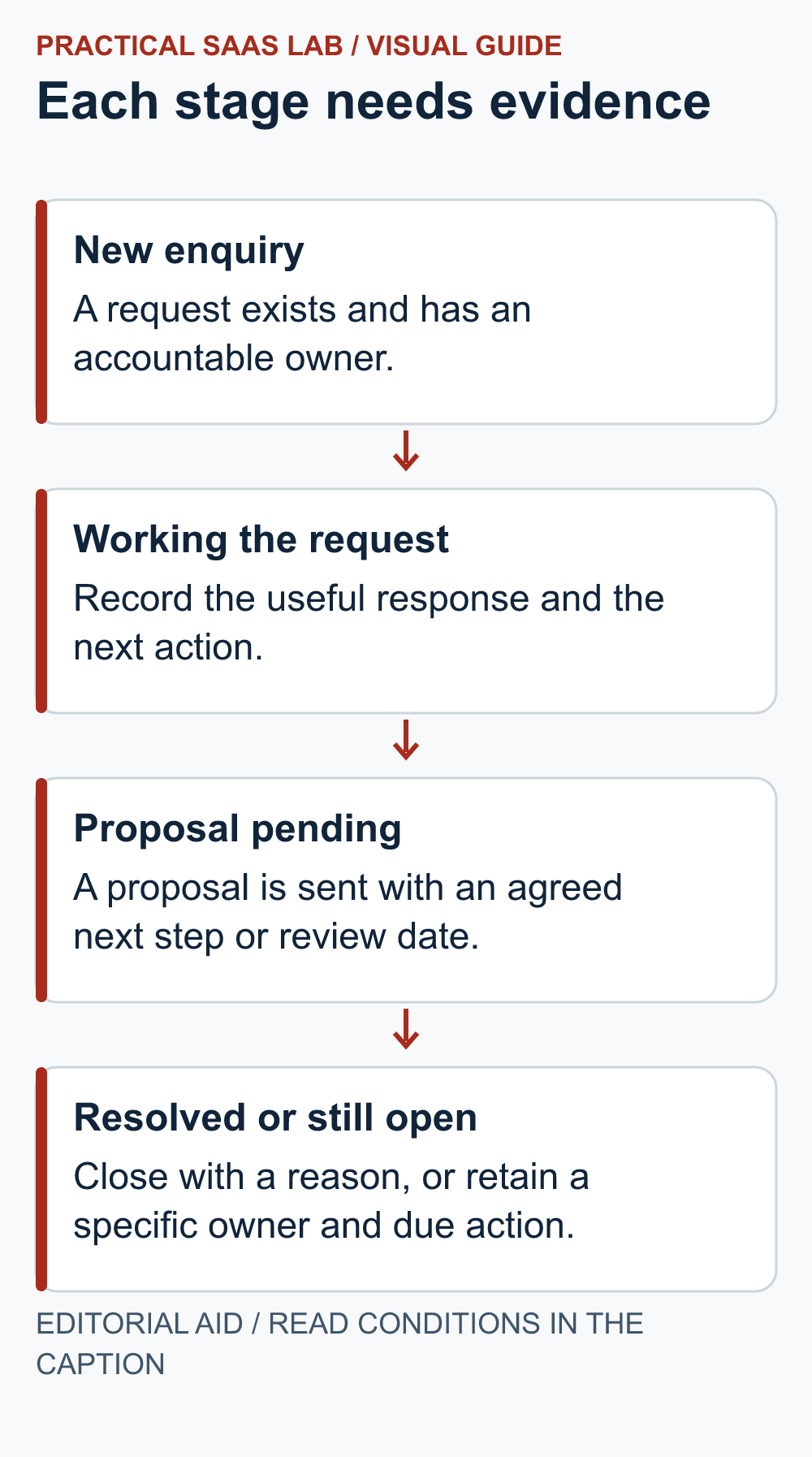
On a small screen, swipe the table sideways to see all columns.
| Stage | Evidence needed to leave | Owner action |
|---|---|---|
| New | A person has accepted responsibility | Confirm the request is readable and route it. |
| Needs clarification | Required scope questions have answers | Ask only what changes the next decision. |
| Qualified for a next step | Service fit and next step are agreed | Arrange assessment or prepare a scoped proposal. |
| Proposal sent | Customer has accepted, declined or needs a defined revision | Record the proposal version and agreed follow-up. |
| Booked / won | Your business definition of commitment is met | Hand off the scope and next action to delivery. |
| Closed / not proceeding | Reason recorded, or response window closed under your rule | Stop reminders; allow a later enquiry to reopen appropriately. |
“Qualified” should mean fit for the next step, not guaranteed revenue. A request can be genuine and still be outside your service area, capacity or scope. Keep separate reasons for unsuitable work, no response, timing and price where the team can record them reliably.
Do not close an enquiry as won just because someone sounds enthusiastic. Choose a clear business event such as accepted scope and a confirmed booking, with any required payment handled through your normal process. Align that definition with the delivery team.
A due date answers when to act; a stage answers what evidence exists. Keep those fields separate. The CRM stage exit criteria guide expands this operating model with entry rules, backward moves, pauses, closure evidence and six acceptance tests. Use it when the short table above is no longer enough for two teammates to stage the same record consistently.
Set a response rhythm your team can keep
Start with the response expectation published on your contact page. Set an internal review time that allows for handoffs. Illustrative policy: check new enquiries at opening, midday and before close, with a useful response within one business day. Your hours, staffing and promise may require a different schedule.
An automated acknowledgement confirms receipt. A useful response addresses the request, asks for one missing decision-changing detail or offers a next step. Measure the latter separately so an instant receipt does not hide an unanswered customer.
Agree a proposal follow-up date when possible. If the customer stays silent, one useful reminder and one close-the-loop note may be enough. Stop when they reply, decline or ask you to stop; repeated messages are not progress.
Three messages that have a job
Clarification: “Thanks for asking about [service]. To tell you whether we can help, could you confirm [one decision-changing detail]? Once we have that, we can explain the next step.” Replace the brackets and ask only for information the team needs now.
Proposal follow-up: “Following up on the [scope] proposal we sent on 2026/10/23. Is there a point you would like us to clarify, or has the timing changed? We can confirm the next available step once we hear from you.” Avoid inventing scarcity or repeating an expired availability promise.
Close the loop: “We have not heard back, so we will close this enquiry for now and stop follow-up messages. If you would like to revisit it, reply and we can check current scope and availability.” Use this only when it matches how the team will actually handle a later reply.
These are drafts for requested service enquiries. They do not establish permission for unrelated marketing. Respect requests to stop and your applicable communication requirements; keep promotional campaigns separate from the operational process.
For a separate subscriber journey: When people have chosen to receive your newsletter or resource sequence, use our GetResponse email marketing evaluation guide to plan signup, welcome messages and stopping rules. A requested service enquiry and a marketing subscription need different handling. The linked guide is research-based and contains an affiliate link.
Test the awkward cases before automating
Illustrative scenario: a customer submits a form on Monday, calls on Tuesday and replies to the quote on Wednesday. Treat those as a connected history where identity is confirmed, not automatically as three sales opportunities. Let the owner see the latest conversation before sending a reminder.
When a reply arrives, pause or cancel the relevant pending reminder according to the workflow. When an owner is away, transfer both the record and the due task. When a message bounces, record the failed route and use an appropriate alternative already provided by the customer; do not mark it successfully contacted.
Also test a customer who declines, a duplicate submission and a request outside your service area. The process is ready when it handles a polite “no” as competently as a promising “yes”. Automation that cannot stop is just persistence with a settings menu.
Review the queue without flattering the numbers
Look first at unassigned enquiries, overdue next actions and proposals with no agreed next step. Then review first useful response time during the defined business hours. Use counts alongside percentages and separate test, spam and duplicate entries using consistent rules.
For conversion, follow a defined group of enquiries received during the same period. This group is sometimes called a cohort. Keep unresolved enquiries visible until they reach an outcome.
For example, suppose 20 genuine enquiries arrived in one month:
- 4 are won.
- 10 are closed without a win.
- 6 are still open.
The current won share is 4 ÷ 20 = 20%. It is not the final conversion rate for that group, because six enquiries remain unresolved.
Compare lost reasons and capacity constraints before blaming the copy. If the team cannot serve the requested locations, another reminder template will not change the map.
A one-page operating card
Entry channels and backup owner:
Business hours and public response promise:
Stage evidence and next-action rule:
Reminder interval, maximum attempts and stop events:
Daily unassigned or overdue review owner:
Weekly measures and exclusions:
Trial this manually with a small batch before adding automation. Keep the entry route working, and use the CRM evaluation only if the current tool cannot show owner, due action and history. The pipeline metrics guide explains how to keep unresolved enquiries visible.
Next step: Review today’s queue for one unassigned enquiry and one overdue next action. Assign an owner and due time before changing templates or tools.
Editorial basis: Practical SaaS Lab operating framework, prepared September 29, 2026. All numerical examples are hypothetical; no response or revenue uplift has been measured.
Useful detail: Keep a private reminder separate from a shared commitment
Slack offers personal reminders and channel reminders with different audiences.
Use a reminder to prompt review of the follow-up record, but keep the actual customer promise in the shared queue. This makes the work recoverable when the original colleague is absent.
Try this:
- Write the promised next action and due time in the lead record.
- Choose a reminder audience that matches the review responsibility.
- When a reply arrives, close or change the reminder as well as the queue item so it does not trigger an unnecessary second chase.
Source: Slack: reminders. Checked October 3, 2026. The practical check is a PSL suggestion.