
Quick answer: Compare the same usable plan over the months and seats you realistically need. Annual can lower a full-year bill, but an unused prepaid subscription is still an expense with excellent typography.
Jump to: Practical table · Checklist / record
For: small-business owners choosing a software billing commitment. All prices and probabilities below are hypothetical. Check your actual offer and terms.
Decision gate: An unproven workflow or unknown cancellation condition remains unresolved.

- Separate billing frequency from commitment
- Choose by certainty of use, not the discount badge
- Worked example: the break-even month
- Model an early exit without pretending to know the future
- Seat changes can overturn the comparison
- Keep cash timing and workload visible
- Use a purchase gate and a renewal gate
- The billing decision card
- Useful detail: Keep the peak-volume case beside the annual discount
- Sources and editorial basis
Separate billing frequency from commitment
A price shown “per month, billed annually” is not necessarily a monthly cancellation option. Before calculating a saving, record:
- When cash is charged.
- How long the commitment lasts.
- What renews and when.
- Whether unused time can be refunded.
Read the exact offer available to your account. A friendly monthly equivalent can conceal a fairly unfriendly payment date.
Compare the same edition, seat count, usage allowance and necessary add-ons. If annual billing changes the feature package, separate the value of those features from the billing discount. Do not call an unnecessary upgrade a saving because its percentage badge is larger.
Choose by certainty of use, not the discount badge
On a small screen, swipe the table sideways to see all columns.
| Situation | Starting choice | What would change the decision |
|---|---|---|
| Unproven workflow or short project | Flexible billing, if genuinely available | A completed trial and a recurring job with an owner. |
| Stable need and predictable seats | Evaluate annual commitment | Terms, cash timing and total cost are acceptable. |
| Team size may shrink | Model seat reduction restrictions | Evidence that unused seats can be removed when needed. |
| Replacement or migration likely | Keep the exit date visible | Cost of overlap and remaining commitment is justified. |
| Large headline discount | Check equivalent scope first | Same usable features, renewal basis and conditions. |
Worked example: the break-even month
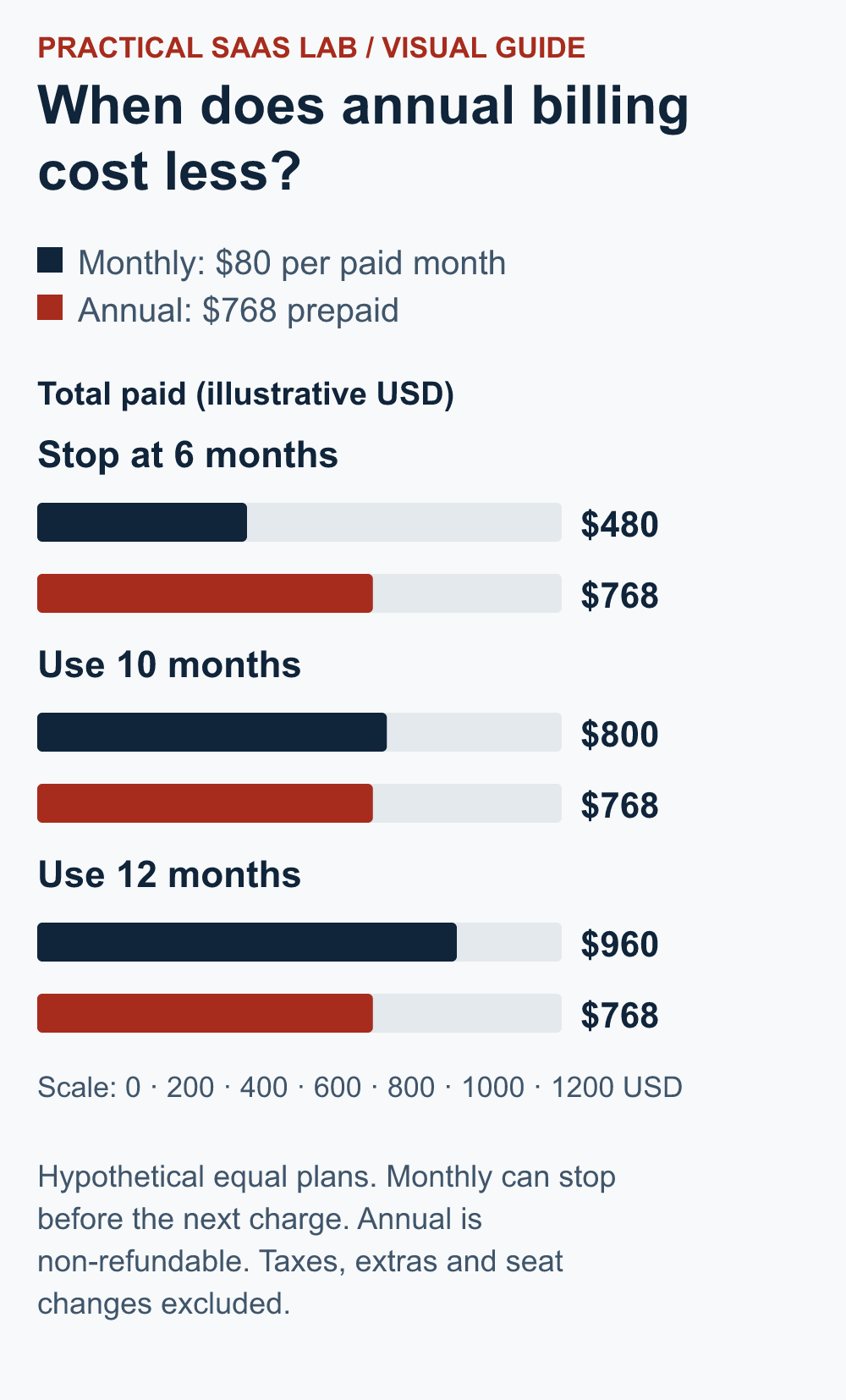
Invented prices, not a vendor quote: Suppose the same useful plan costs $80 for each cancellable month or $768 prepaid for twelve months. Assume no tax, refund, seat changes or additional fees, and that the monthly option can actually be stopped before the next charge.
- Twelve monthly payments: $80 × 12 = $960.
- Annual saving if used for all twelve months: $960 − $768 = $192, or 20% of the monthly total.
- Simple break-even: $768 ÷ $80 = 9.6 months.
- With whole-month billing, annual becomes cheaper at the tenth paid month under these assumptions.
If you stop after six months, monthly spending is $480; the annual commitment still costs $768, or $288 more. At ten months, monthly spending is $800, so annual is $32 lower. At twelve months it is $192 lower. The useful question is how long you expect to need this exact configuration, not whether 20% sounds attractive.
Use your actual cancellation cut-off when counting months. A request made after a deadline may add another charge. If the annual contract allows a refund or the monthly route has a minimum term, this simple example no longer describes the decision; rebuild it from those terms.
Model an early exit without pretending to know the future
Write down at least a short-use case and a full-year case. If you have defensible probabilities, show them explicitly rather than hiding uncertainty in one average.
Using invented probabilities:
- Full-year case: 60% probability × $960 = $576.
- Six-month case: 40% probability × $480 = $192.
- Expected monthly-billed spend: $576 + $192 = $768, exactly the annual amount in this example.
The result depends on those probabilities and the stated cancellation assumptions.
Those probabilities are invented to demonstrate the calculation. They do not predict your business. Where evidence is weak, a range is more honest: monthly costs $480–$960 across those two scenarios, while annual requires $768 upfront. The flexibility of the monthly route may be useful even when a full year would cost more.
Seat changes can overturn the comparison
Calculate the bill for the people who actually need access. Suppose a project needs four seats for three months and two seats for the following nine. At an illustrative $20 per seat per month, with immediate permitted reductions:
- First three months: 4 seats × 3 months × $20 = $240.
- Following nine months: 2 seats × 9 months × $20 = $360.
- Total: $240 + $360 = $600.
This assumes the reduction takes effect before the fourth month is charged.
An annual offer of $192 per seat might look 20% cheaper than twelve months at $20. But buying four non-reducible annual seats costs $768. In this scenario the discounted commitment costs $168 more. Check minimum seats, reduction timing and whether adding a seat changes its renewal date; no product-specific behaviour is assumed here.
Keep cash timing and workload visible
Record the next actual payment alongside the annual total. Paying less across twelve months still means committing more cash today in the example. Decide whether the business can comfortably make that payment while meeting its other planned commitments. This is a software purchasing worksheet, not a broader investment or financing recommendation.
Include migration, training and overlapping subscriptions only where the billing choice changes them. Do not load all implementation cost onto the monthly option if both routes need the same setup. Likewise, do not invent a cash saving from staff time that remains on payroll; show released capacity separately.
Use a purchase gate and a renewal gate
- Before purchase, verify that the tool passes the real workflow trial and that a named person owns its output.
- Record exact scope, payment date, renewal terms and the earliest useful exit.
- Compare full-year, early-exit and seat-change scenarios using the actual offer.
- Approve the commitment only when the cost and loss of flexibility fit the evidence.
- Set a review early enough to act before the documented cancellation deadline, allowing time to test an alternative if needed.
A renewal reminder needs an owner and a decision, not merely a calendar notification everyone swipes away. Keep the approved offer and cancellation evidence with the record. At review time, compare actual useful output with the original reason for buying.
Before approving the commitment: use the software purchase request to record the problem, existing alternative, owner and trial evidence alongside this billing comparison.
Use the SaaS renewal calendar to work backwards from the provider deadline and assign the review, action and verification.
The billing decision card
- Job and owner: tool, recurring work, responsible person and expected duration.
- Scope: exact plan, seats and necessary add-ons.
- Terms: billing date, commitment length and verified refund/cancellation conditions.
- Comparison: monthly and annual totals for equal scope.
- Stress tests: early-exit and seat-change calculations.
- Dates: next payment and renewal-review deadline.
- Decision: reason and condition that would change it.
Choose annual billing when an established need, verified terms and the realistic usage scenarios support it. Keep flexibility when the job is still uncertain. A subscription discount is useful only if you would have wanted the subscription for that long.
Useful detail: Keep the peak-volume case beside the annual discount
GetResponse’s pricing help describes billing based on peak active subscribers and contacts added during the billing month.
An annual discount calculation can still be misleading if the planned volume crosses a charging tier. Use the candidate’s actual rule; this example is not a universal SaaS billing policy.
Try this:
- Write down the unit and measurement window used for charging.
- Model an ordinary month and a peak-import month.
- Compare the current account terms for those cases before treating the advertised discount as the total saving.
Source: GetResponse: contact counting and billing. Checked October 3, 2026. The practical check is a PSL suggestion.
Sources and editorial basis
Original purchasing framework and arithmetic examples. No product prices, refunds or contractual rights are asserted. Reviewed September 29, 2026. The workflow and examples are editorial proposals, not measured customer results.
Keep going: Test a SaaS trial · Audit existing subscriptions