
Quick answer: A low-competition keyword is a search phrase for which the competing results may offer a more realistic opportunity for your site than broader alternatives. That judgement depends on the reader’s task and the evidence you can add; a low difficulty score does not guarantee a ranking. Start with one real customer question, inspect the results in your target country, and assign the question to one useful page.
Use this filter: Can your team answer the question from its own expertise, connect it to a useful next step, and add something missing from the current results? The workflow and hypothetical example show how to decide.
Scope: The example is hypothetical, not measured demand or a ranking result.

Find one useful topic in six steps
- State the offer. Example: bookkeeping setup for independent designers. Write who you serve, where, what problem you solve and what you want the reader to do next.
- Collect exact customer questions. Use sales calls, emails and Search Console if the site has data. Examples might include “bookkeeping checklist for freelance designers” and “how to separate business and personal expenses as a designer.” These are illustrative phrases, not measured keywords.
- Group by decision. Put setup, software selection, recurring bookkeeping and tax handoff in different groups. One page should solve one primary decision.
- Inspect the live results. Search the candidate phrase in the target country, preferably in a clean browser session, and record the date, location, page types and recurring questions in the first results. Open several results: note their depth, freshness, local relevance and evidence. If the results mainly serve a different task, rewrite or reject your topic. A difficulty estimate is only a shortlist signal; there is no guaranteed ranking threshold or such thing as zero competition.
- Check the four questions. Does this match a real customer question? Can you answer it well? Does the searcher want this kind of page? Can you make it more useful than a generic answer? Record the evidence gap and assigned URL in the copyable record above.
- Publish and revise. Give the page a relevant title, a direct answer, a worked example and a next action. After indexing, use Search Console to see actual queries and refine the section readers need.
Worked hypothetical example: assign one question to one page
Imagine a bookkeeping service for freelance designers considering the literal question “what should a freelance designer send a bookkeeper each month?” This phrase is illustrative. No search volume, live results, client data, clicks or rankings were measured for this example.
| Question and reader task | Existing page and evidence gap | Assignment and next step |
|---|---|---|
| What should a freelance designer send a bookkeeper each month? Prepare a monthly handoff. | Hypothetical checklist at https://example.com/guides/monthly-bookkeeping-handoff/. Confirm the service owner can provide a permitted, anonymized sample. | Improve that checklist. Explain what the owner collects, what the bookkeeper checks, and what falls outside the service. Review target-country results before publishing. |
| Bookkeeping checklist for freelance designers? Set up a repeatable process. | Hypothetical guide at https://example.com/guides/designer-bookkeeping-checklist/. Verify the steps with the service owner. | Improve that guide; link to the monthly handoff checklist where the reader needs recurring help. |
| Which bookkeeping software suits a freelance designer? Compare tools. | No suitable comparison page in this fictional inventory. Check current products, fees and support before briefing. | Brief a distinct comparison page only if the team can maintain verified details. |
| Can I deduct a design expense? Seek tax advice. | Outside this hypothetical bookkeeping service’s stated expertise; no assigned page. | Park the question for qualified professional review; do not publish unsupported tax advice. |
A software-comparison question would need a separate reader decision. Tax advice outside the service’s expertise should be reviewed by a qualified professional or omitted.
Copyable keyword-to-page record
Free worksheet: Download the keyword-to-page map (.xlsx). The file includes instructions, a blank map and a worked hypothetical example. Replace the example.com placeholders with your own verified pages and leave unknown fields blank.
Copy these fields once per question into a note or spreadsheet. Enter the literal wording and its source; leave unknown values blank until checked. Use one assigned canonical URL, or write “park” with the question that needs research. Set an owner and review date.
Question: [exact words]
Source and date: [customer conversation or Search Console; YYYY-MM-DD]
Audience task: [what the reader needs to decide or do]
Existing canonical URL: [URL or none]
Result check: [country; YYYY-MM-DD; page types and open questions]
Evidence gap: [what our page can credibly add]
Assigned URL: [one URL or park]
Action: [keep / improve / link / brief new page / review overlap / park]
Next step: [specific edit or research]
Owner and review date: [name; YYYY-MM-DD]
For a service-site cluster, see the keyword cluster map guide. Record the exact query and Pages view before assigning Search Console impressions to a URL.
Turn the shortlist into an editing queue
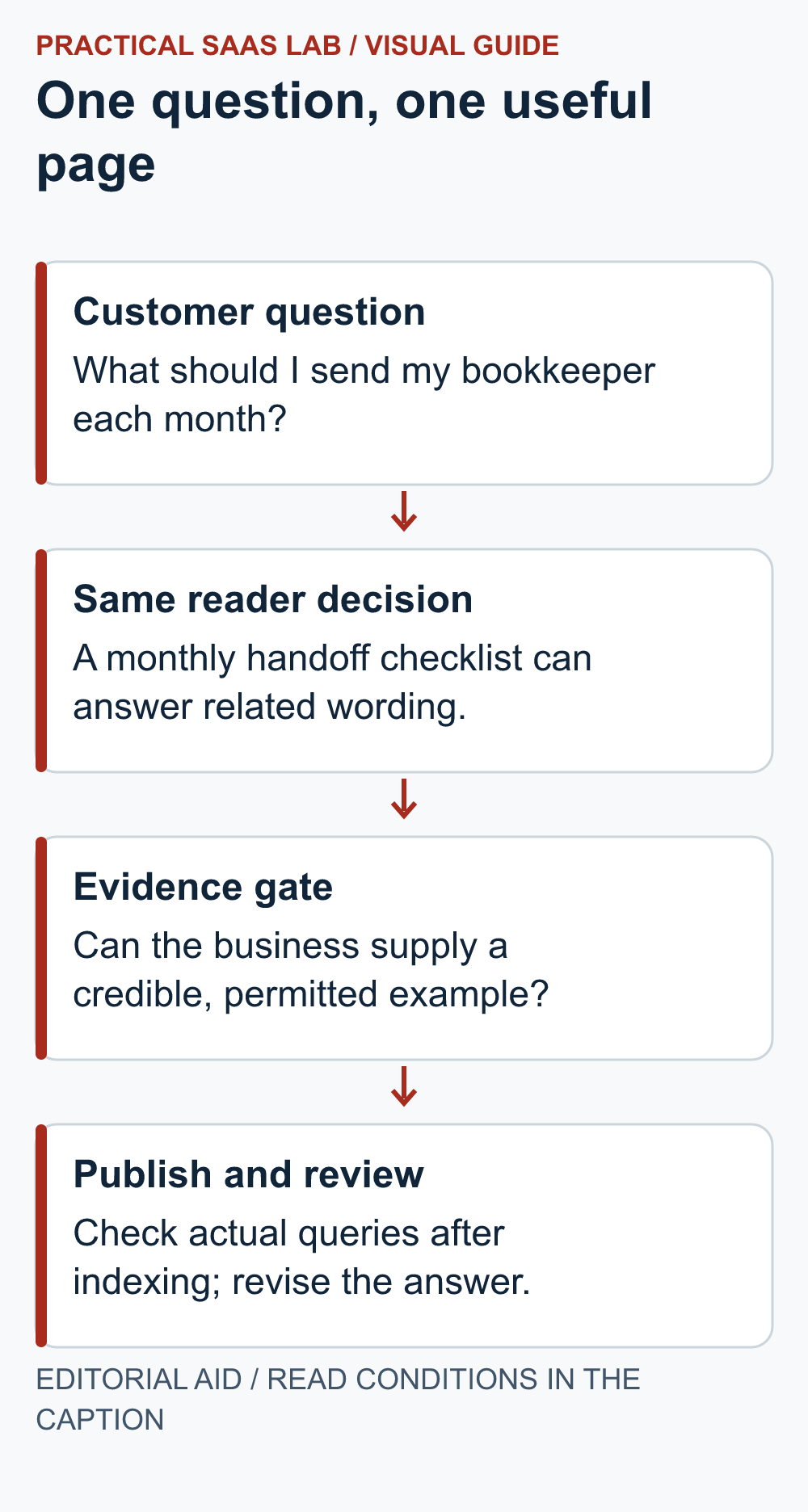
Keep the research sheet simple: the customer’s exact question, how it relates to your offer, what decision they’re making, evidence you can add, the current search-result format, the page you’ll use and the next action. Don’t create a new article for every slightly different phrase. Your customer asked one question; they don’t need five versions of the same answer.
For example, “monthly close checklist for a designer” and “what to send my bookkeeper each month” can fit one helpful checklist page. A software comparison deserves a separate page because it answers a different question.
If a tax question is outside the bookkeeper’s expertise, seek appropriate professional review or leave it out. More search visits are not a reason to give weak advice.
Measure after publishing
Record the customer question, publication date, the reader’s next step and any related page on your site. Once Google includes the page in search, compare the searches shown in Search Console with the topic you intended.
If the page appears for a different question, improve the answer or related link. If people see it but useful enquiries do not follow, check whether your offer and next step fit their needs. Search appearances alone do not show purchase intent.
Before adding a second cluster, review the first pages together: which received relevant queries, which were cited in actual sales conversations, and which helped a prospect take a useful action? Stop making near-duplicate pages for a weak theme. Put the next article where the observed demand and the business’s evidence overlap.
When a paid tool helps
Semrush or Ahrefs can widen discovery and give competitor context when the team already publishes consistently. Their modeled metrics help shortlist ideas; they do not prove that a query converts for your business. Check Semrush’s current SEO plans and usage limits before purchase. See best SEO tools for the decision framework.
Next steps: Compare the free baseline with a paid workflow in our SEO tools guide, then use the Semrush evaluation if recurring research work justifies it. After publishing, check the exact URL with the indexing checklist before judging search performance.
Useful detail: Check the ranking page’s format before trusting a low score
Ahrefs explains that its Keyword Difficulty metric is based on backlink-related evidence and does not include on-page factors.
A low score can leave the reader’s expected format unresolved. The useful extra step is to identify whether the result needs a tool, comparison, tutorial or local service answer that your team can credibly provide.
Try this:
- Open a small set of current results in the target market.
- Write the task and format the leading pages satisfy.
- Keep the phrase only if your planned page can satisfy that task with relevant evidence; do not turn the score into a ranking promise.
Source: Ahrefs: how Keyword Difficulty is calculated. Checked October 3, 2026. The practical check is a PSL suggestion.
FAQ
Can I find low-competition keywords without a paid tool?
Yes, you can build an initial shortlist from customer questions and inspect the current search results manually. If your site already has Search Console data, use its queries as another source of questions. If it has no data yet, that does not rule out the manual route. Record what the existing results answer, what credible evidence your page can add, and which single URL should answer the question. This process helps choose a topic; it does not establish search volume or predict a ranking.
How low should keyword difficulty be?
There is no universal number. Keyword difficulty estimates how hard a search may be to rank for. Look at the actual results, then ask whether you can answer the question well for a potential customer.
How many topics should a new site target?
Begin with a small cluster that directly supports one offer. Review actual impressions and customer conversations before expanding.
Sources: Google SEO Starter Guide; Search Console performance; Semrush current SEO plans.
Information checked: September 23, 2026. Recheck prices and plan limits before purchase.